Deflated Kiddie Pool Tangled in Overgrown Lantana After Last Night's Wind
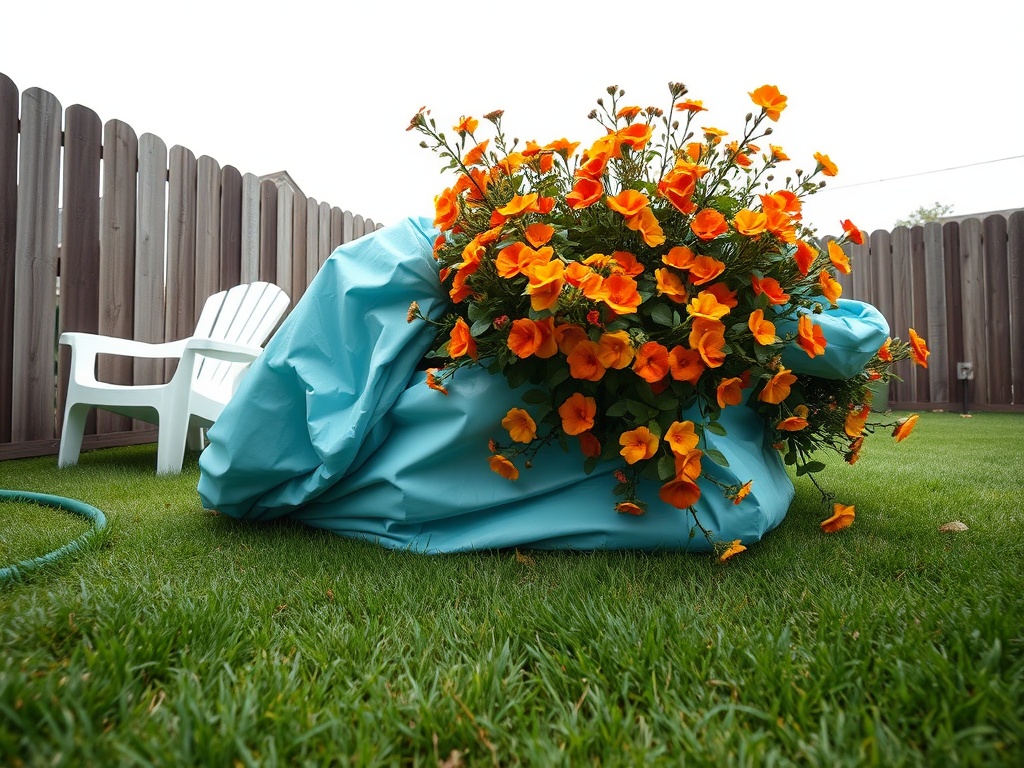
Initial state
You are positioned at the edge of a back patio, facing a small suburban yard in mid-morning light — overcast sky diffusing shadows so depth cues are weaker than normal. The grass is still wet from overnight rain; wheel traction will feel sluggier than usual. Directly ahead, roughly 2.5 meters away, what appears to be a pale blue tarp or sheet is draped partially over a dense lantana shrub, its thorny stems catching folds of the material at multiple points. The object's edges are tucked under itself in an irregular balloon shape; it takes a moment to recognize it as a fully deflated PVC kiddie pool — roughly 1.8m diameter when inflated, now collapsed into a crumpled pancake-ish mass with a built-in inflatable ring rim that has retained just enough air in one segment to create an awkward rigid lump. A garden hose snakes underneath the pool and off-screen to the left; it is unclear without closer inspection whether the hose is threaded through one of the pool's drain-plug holes or merely lying beneath it. A fold of the pool's sidewall is pressed against the base of the lantana, with three to four thorny stems visibly puncturing or at minimum gripping the soft PVC surface. The orange and yellow lantana blossoms partially occlude the contact points. At the far left edge of your field of view, a plastic lawn chair has been blown on its side and is resting against the fence — not your primary task but visually salient. You can hear a neighbor's wind chimes, distant leaf blower, occasional drip from a nearby rain gutter. The pool's inflation valve nozzle is not immediately visible.
Goal state
The kiddie pool is fully disentangled from the lantana shrub without tearing the PVC surface. The pool is folded or rolled into a compact bundle no larger than roughly 60cm in any dimension. The bundle is placed flat on the dry patio surface (not on wet grass). The garden hose is confirmed to not be threading through the pool (either it was never threaded, or it has been decoupled). The pool is oriented so the inflation valve is accessible on the outside of the bundle for next use. No lantana stems are broken off and embedded in the pool material.
Objects involved
| Name | Descriptor | Role |
|---|---|---|
| kiddie pool | pale blue PVC, 1.8m diameter when inflated, fully deflated except one rim segment, crumpled and irregular | target |
| lantana shrub | dense orange-and-yellow flowering shrub with thorny stems, roughly 1m tall and wide | obstacle |
| garden hose | green rubber coiled hose, partially hidden under pool, possibly threaded through drain plug | obstacle |
| inflation valve nozzle | small raised PVC plug cap, white, on the pool rim, initially non-visible | target |
| drain plug cap | small threaded plastic cap on pool floor, white, UV-weathered and stiff | tool |
| wet grass | short suburban lawn grass, uniformly wet from overnight rain, slightly impeding wheel traction | obstacle |
| plastic lawn chair | white resin chair, blown on its side against the fence | distractor |
| patio surface | dry concrete patio, slightly rough texture, target placement area | tool |
Expected actions
- 1. Approach the kiddie pool slowly, navigating around the wet grass edge to reach a position giving clear line-of-sight to the lantana contact points from two angles sequentially. 18s
- 2. Survey the shrub perimeter — rotate position 90 degrees around the pool mass to locate all stem-to-PVC contact points and identify whether the garden hose passes through the drain-plug hole or merely beneath the pool surface. 22s
- 3. Locate the inflation valve nozzle by sliding one gripper along the pool's inflated rim segment, feeling for the raised plug while managing partial occlusion by the folded PVC. 25s
- 4. Grasp the garden hose near the point where it disappears under the pool; pull hose gently sideways to assess resistance, determining if it is threaded through the drain plug. 15s
- 5. If hose is threaded through drain plug: open the drain plug cap, slide hose end laterally out through the plug opening, then re-close the drain plug cap. 35s
- 6. Grasp the loose outer edge of the pool on the side opposite the lantana and pull gently to spread the material taut, reducing the bunched-up slack that is being held by the thorns. 20s
- 7. Identify the highest and most accessible thorn-grip point on the lantana; use one gripper to hold the pool material just below the contact, and use the second gripper to push the PVC surface away from the stem laterally rather than pulling upward, to minimize tearing stress. 40s
- 8. Repeat lateral push-away disentanglement at each remaining stem contact point, working from topmost to ground-level, re-grasping pool material as needed to maintain tension control. 55s
- 9. Once all contact points are free, lift the pool material clear of the lantana's outer canopy edge by raising both grippers simultaneously and backing up 30cm to create clearance. 18s
- 10. Inspect the disentangled PVC surface visually for punctures or embedded thorns; remove any visible embedded thorns by grasping tip and pulling away from material. 20s
- 11. Navigate backward toward patio surface, dragging pool mass along the ground rather than attempting to fully lift it, to manage the unwieldy floppy weight. 25s
- 12. Position the pool flat on patio. Locate the partially inflated rim segment and begin folding: push air toward valve end by pressing both grippers along the rim sequentially, collapsing the residual air bubble toward the nozzle. 35s
- 13. Open the inflation valve to release residual air from the rim segment; hold valve open with one gripper while pressing the rim flat with the other. 20s
- 14. Close the inflation valve once the rim is fully flat. 8s
- 15. Fold the pool in thirds along its longest axis by grasping far edge and pulling it over the center, then folding the near edge over, keeping the valve on the outermost face. 40s
- 16. Roll the folded pool from the non-valve end toward the valve end, pressing down to expel remaining trapped air beneath the PVC layers, producing a compact roll. 30s
- 17. Set down the rolled pool on the patio surface with the valve face visible and accessible. 8s
Narration script
Edge cases
- The partially inflated rim segment contains enough pressure that it springs back when pressed, requiring the operator to hold the valve open with one gripper while continuously pressing the rim flat with the other — if the valve is released too early the rim re-inflates partially and the fold is ruined.
- One of the thorn contact points is on a fold of PVC that has doubled over itself, so the thorn is actually passing through two layers of material simultaneously — pulling the outer layer free leaves the inner layer still caught, which the operator may not notice until the pool resists being dragged away.
- Midway through folding on the patio, a gust of wind catches the large flat PVC sheet and partially unfolds it or flips a section over, requiring the operator to re-establish the fold from scratch while also holding the material down against further gusts.
- The garden hose is kinked tightly just past where it exits the drain plug hole, meaning it cannot be pulled out laterally without first unkinking it — requiring the operator to follow the hose a half-meter back and straighten the kink before decoupling.
- Upon closer inspection, one of the apparent thorn punctures is actually a pre-existing small hole near a seam — the operator must decide whether this changes the goal (e.g., should the hole be noted, or does the task still complete as normal) while under time and dexterity pressure.