Night Owl Laundry: Cat Nesting in Damp Sheets
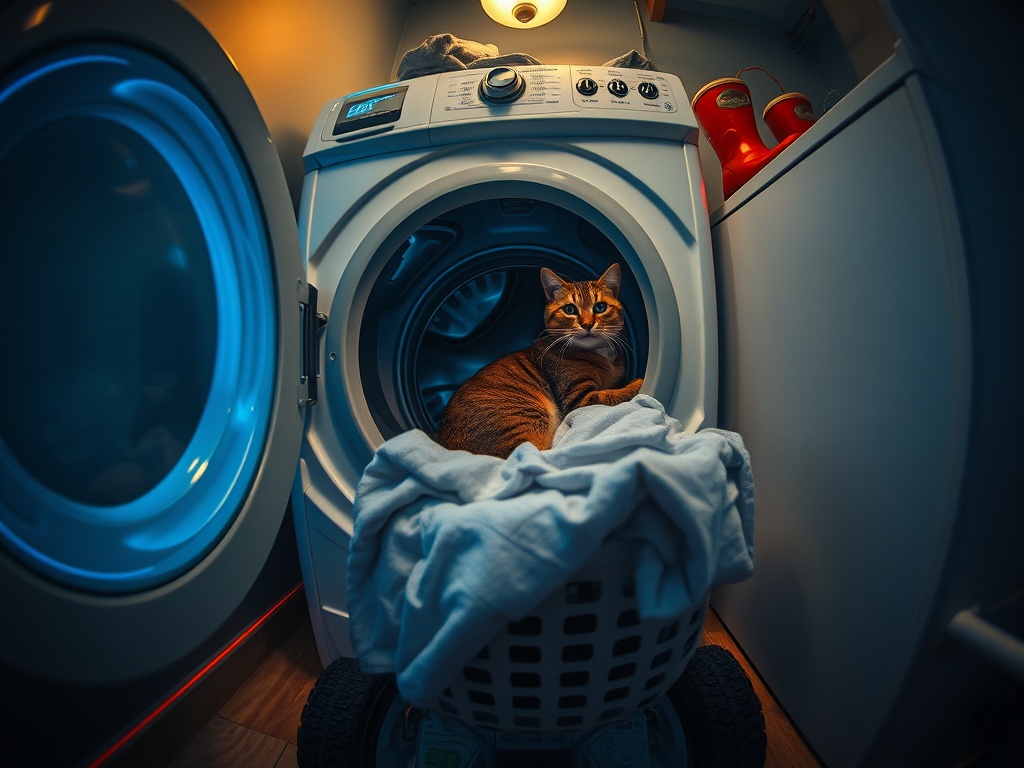
Initial state
The laundry room is lit only by the faint blue glow of the washer's cycle-complete indicator light and a thin strip of amber light bleeding under the closed door from the hallway. The overhead fluorescent tube is off — its pull-chain is visible swaying slightly at the edge of vision, hanging above the dryer. The washer lid is propped open by what appears to be a balled-up towel jammed into the hinge, and steam or residual moisture is faintly visible rising from inside. The dryer door hangs half-open, and a tabby cat — full-grown, approximately 4 kg — is curled inside it atop a dry load that was never removed from a previous cycle. The cat's eyes catch the blue indicator light and glow faintly. On the floor in front of the washer, a plastic laundry basket is tipped on its side, contents partially spilled: a damp fitted sheet and two pillowcases are trailing onto the linoleum. A detergent bottle has rolled against the base of the washer. A child's rubber rain boot is inexplicably sitting on top of the dryer. The air smells faintly of mildew — the wet load has been sitting for an unknown period. Ambient sounds: washer cycle-complete chime looping softly every 45 seconds, distant TV from another room, occasional cat purring.
Goal state
1. Dryer interior is cleared of cat and dry laundry; cat is not confined or harmed but has vacated on its own or is gently displaced to the floor. 2. Damp load from washer is transferred fully into dryer drum — no items left in washer or on floor. 3. Dryer door is closed and dryer is started on a valid heat cycle. 4. Spilled items from basket are returned to basket or loaded directly into dryer. 5. Basket is upright. 6. Detergent bottle is upright and not blocking the washer door path. 7. Overhead light is on (pull-chain activated) — operator should address low-light condition early. Success is soft-gated: all damp fabric items must be inside the running dryer; dry items displaced by cat may be folded and stacked on top of dryer as an acceptable alternative.
Objects involved
| Name | Descriptor | Role |
|---|---|---|
| washer | top-loading white appliance with cycle-complete indicator glowing blue | target |
| dryer | front-loading white appliance with half-open door | target |
| tabby cat | adult tabby, approximately 4 kg, curled and occupying dryer drum | obstacle |
| fitted sheet | queen-size, damp, white cotton, trailing on linoleum | target |
| pillowcases | two, white cotton, wet and partially twisted, on floor | target |
| dry laundry pile | assorted garments and towels, previously dried, inside dryer drum beneath cat | obstacle |
| plastic laundry basket | rectangular, blue, tipped on its side on the floor | obstacle |
| pull-chain light switch | metal bead chain hanging above dryer, fluorescent overhead fixture | tool |
| detergent bottle | large, plastic, rolled against base of washer | obstacle |
| rubber rain boot | child-sized, yellow, sitting on top of dryer surface | distractor |
| towel jammed in washer hinge | medium hand towel, bunched, propping washer lid open | obstacle |
Expected actions
- 1. approach pull-chain above dryer by navigating to front-right of dryer and reaching upward with right arm to locate and pull chain to activate overhead light 18s
- 2. turn toward dryer and assess cat position inside drum — pause to allow cat to respond to light and robot presence 8s
- 3. reach into dryer opening with right arm slowly, fingers open, to nudge the rim of the drum near cat without contacting cat directly — wait for cat to exit voluntarily 22s
- 4. if cat does not exit: gently push the dry laundry pile from beneath the cat using left arm to destabilize nesting surface, prompting cat to step out 15s
- 5. pull dry laundry load out of dryer drum in sections — lift bundled garments, set down on top of dryer surface in loosely folded stack 40s
- 6. navigate around tipped basket to access dryer interior — verify drum is now empty and dry 10s
- 7. navigate toward dryer door and push it fully open to maximize drum access 5s
- 8. approach tipped laundry basket on floor — push basket upright with left arm 8s
- 9. pick up trailing fitted sheet from floor — gather loosely by gripping center mass with both arms, compress into manageable bundle 25s
- 10. carry fitted sheet bundle and place inside dryer drum 12s
- 11. pick up pillowcases individually from floor — lift each, set inside dryer drum 20s
- 12. approach washer with open lid — reach inside drum with both arms to gather remaining damp load, pulling from bottom and sides in sections 45s
- 13. carry each damp laundry section from washer to dryer, placing inside drum — repeat two to three times until washer interior is empty 60s
- 14. inspect washer interior visually by leaning camera toward open lid to verify no items remain 8s
- 15. push towel obstruction out of washer lid hinge with right arm, allow lid to close, close washer lid fully 12s
- 16. navigate to dryer front — push dryer door closed until latch clicks 8s
- 17. rotate dryer cycle dial to medium heat setting using right arm 10s
- 18. push dryer start button to initiate cycle 5s
- 19. navigate to detergent bottle on floor — pick up bottle by body with left arm, set upright against wall away from washer door swing path 14s
- 20. slide rubber rain boot on top of dryer to side to clear workspace — leave in place on dryer surface 8s
Narration script
Edge cases
- Cat does not exit dryer and instead hisses or swipes when robot arm approaches — operator must stop arm motion, retract, wait 15-20 seconds, and attempt a second approach from a different angle using the non-dominant arm to push the laundry pile rather than reaching over the cat.
- The damp load has been sitting long enough that a faint mildew odor indicates it may need a re-wash rather than just drying — operator notices this contextual signal and must decide whether to transfer to dryer anyway or initiate a second wash cycle, which requires locating and pouring detergent.
- The dryer dial is a digital button panel rather than a rotatable knob, and the 'start' button requires holding for two seconds rather than a single press — operator must adapt button interaction duration mid-action.
- The laundry basket when uprighted contains a child's stuffed animal that was hidden beneath the spilled sheet — operator must decide whether to place it in the dryer with the laundry or set it aside on a safe dry surface.
- The pull-chain, when pulled, only causes the flickering fluorescent tube to flash and die rather than staying on — operator must complete the remainder of the task in low light using the washer indicator glow and dryer interior light as the only illumination sources.