The Half-Dismantled Bike and the Mystery Box Blocking the Drain
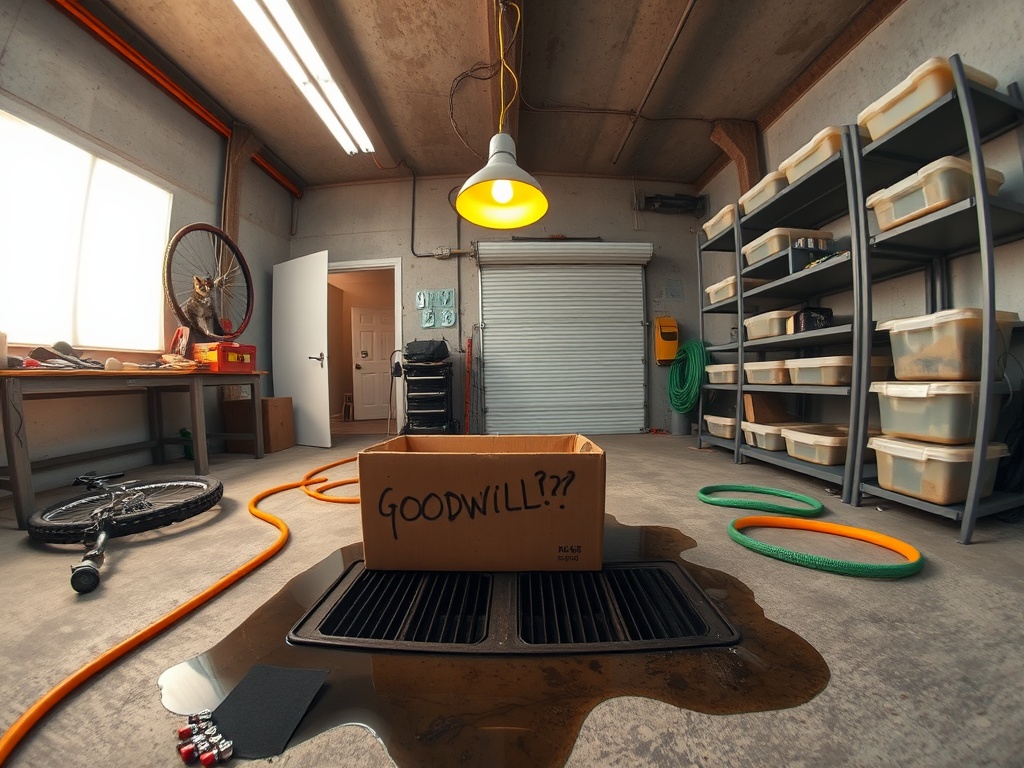
Initial state
You are in a cluttered two-car garage that currently holds zero cars. Fluorescent overhead lights flicker faintly on one side; the other half of the garage is lit by a single hanging work lamp on an orange extension cord that drapes across the floor at ankle-height — a navigation hazard. The garage smells faintly of oil and cat litter. A mountain bike is propped against a workbench, front wheel removed and resting flat against the wall beside it. On the workbench: an open toolbox with sockets scattered loose, a crumpled oil-stained shop rag, and a half-crushed cardboard box sealed with clear packing tape labeled 'GOODWILL???' in black marker — the question marks are original, left by a household member. That box is sitting directly over a floor drain in the center of the garage, and a dark wet puddle has pooled on one side of the box, suggesting water is backing up or has recently drained. You cannot see what is under or behind the box without moving it. Along the right wall: metal shelving with stacked plastic bins, one of which is partially open and leaning at an angle, its lid held by gravity alone. A cat sits on the highest shelf watching you with complete indifference. Near the roll-up door: a garden hose is coiled but not neatly — it has looped over itself twice. At the far left, a standard interior door leads back into the house; it is slightly ajar. Ambient sounds: the flicker-buzz of a dying fluorescent tube, a distant clothes dryer running, the cat shifting weight on the shelf.
Goal state
The floor drain is clear and unobstructed. The 'GOODWILL???' box is relocated to a stable, dry, upright position where it does not block a walkway or a functional fixture. The detached front wheel is re-leaned securely against the bike frame (or at minimum against the wall such that it cannot fall and roll). The extension cord is repositioned so it no longer creates a ground-level trip hazard across the robot's navigation path. The tilting bin on the shelf is secured or re-seated so it will not fall. Soft criteria: the shop rag should not be left on top of the drain-clearing operation area; wet surfaces near the drain should be wiped if the rag is accessible; the cat is not disturbed to the point of knocking items off the shelf.
Objects involved
| Name | Descriptor | Role |
|---|---|---|
| cardboard box | medium-large, partially crushed, sealed with packing tape, marker text 'GOODWILL???' | target |
| floor drain | round metal grate, 15 cm diameter, set flush in concrete floor | target |
| extension cord | orange rubber-coated 12 m household cord, looped on floor | obstacle |
| shop rag | gray cotton, oil-stained, partially stiff | tool |
| mountain bike | black aluminum frame, front wheel detached, propped against workbench | obstacle |
| front wheel | 26-inch, black rubber tire, silver alloy rim, resting flat against wall | target |
| plastic storage bin | large gray bin with translucent lid, leaning on shelf | target |
| cat | medium-size, tabby, sitting on top shelf of metal rack | distractor |
| work lamp | single bulb in metal cage shade, hanging on orange extension cord | distractor |
| toolbox | red metal, open lid, loose sockets scattered on workbench surface | distractor |
| puddle | irregular water pooling on concrete, roughly 20 cm radius, near drain | obstacle |
Expected actions
- 1. approach the floor drain area from the far side to avoid rolling over the extension cord 12s
- 2. navigate around the extension cord by turning toward the workbench side of the garage to maintain clearance 10s
- 3. visually assess the 'GOODWILL???' box — determine weight and stability by pressing lightly on the top surface with one gripper 8s
- 4. slide the box laterally away from the drain toward the open floor area in front of the right-side shelving 14s
- 5. inspect the drain visually once the box is clear — check for debris, standing water depth, or blockage material partially visible at the grate 8s
- 6. lift the shop rag from the workbench surface using a pinch grip at one dry corner 6s
- 7. wipe the wet surface around the drain in overlapping lateral strokes to reduce pooling 18s
- 8. set down the shop rag on the workbench surface away from tools, folded loosely dirty-side in 6s
- 9. approach the right-side shelving unit and visually confirm the tilting bin's lean angle and the cat's current position before touching the shelf 10s
- 10. place both grippers on opposite sides of the tilting bin and push the bin back to flush against the shelf lip until it sits level 12s
- 11. press the bin lid down on both ends with open-palm gripper pressure to reseat the partial closure 8s
- 12. approach the extension cord mid-span and pick it up with both grippers at two points separated by roughly 40 cm 10s
- 13. pull the cord toward the workbench side wall, looping it loosely against the baseboard so it clears the center floor path 16s
- 14. approach the front wheel leaning against the wall and assess whether it is stable — probe gently with one gripper 8s
- 15. lift the front wheel by the hub and set it upright leaning against the bike frame, angled so the axle stub contacts the frame tube for mutual support 20s
- 16. retreat slowly from the bike area, monitoring the wheel's lean angle to confirm it has not begun sliding 10s
- 17. navigate to a central position and perform a 360-degree slow turn to visually audit all completed sub-tasks before terminating the task 18s
Narration script
Edge cases
- The 'GOODWILL???' box is heavier than expected — contents shift when slid, making the box difficult to relocate without tipping; operator must choose between lifting (risk of dropping) or pushing in shorter increments.
- The cat jumps down from the shelf onto the workbench mid-task, sitting directly on the shop rag; the operator must decide whether to wait, work around the cat, or gently slide it — none of which the scenario explicitly prescribes.
- The extension cord is plugged in at the far wall end, meaning pulling it creates tension rather than slack; operator discovers this mid-reposition and must trace the cord back to find the plug before it can be repositioned safely.
- The front wheel has a quick-release skewer that is only partially closed, causing it to catch on the bike frame when leaned against it; securing the wheel requires either opening or fully closing the skewer first.
- When the box is slid off the drain, debris (grit, a dried paint brush, a flattened water bottle) is revealed underneath it — operator must decide whether clearing drain-adjacent debris is within task scope or not, given the ambiguous goal definition.