Leaking Coolant Drip Tray Before the Car Returns
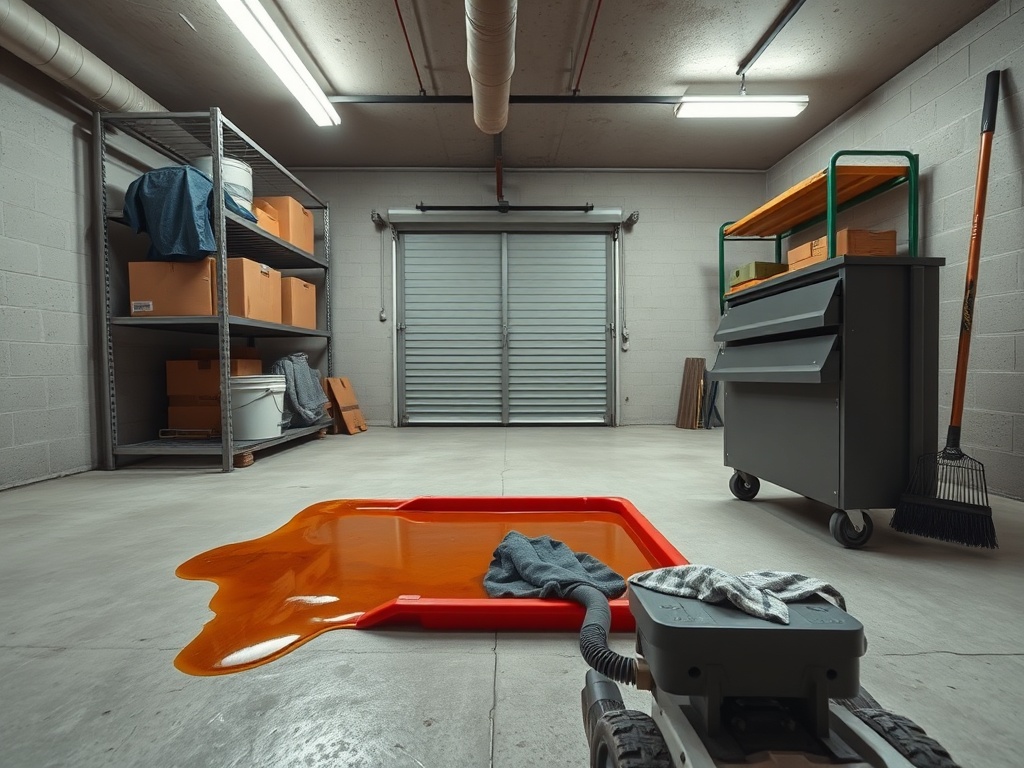
Initial state
You are facing the interior of a single-car garage at approximately 6:45 PM. The main overhead fluorescent tube on the left is flickering at roughly 2 Hz, causing intermittent shadow shifts across the floor. The right overhead light is fully functional. A text notification on the HUD overlay reads: 'Dad parking in ~7 min.' The garage door is closed behind you. Directly ahead, a dark green 2-door sedan is absent — its parking space is a concrete slab marked with two worn tire guides. A slow drip of amber-brown coolant is falling from an overhead PVC pipe coupling at roughly one drip per four seconds, landing in an already-partially-full red plastic drip tray (roughly 40% full) that sits slightly off-center on the concrete. The tray is tucked partially under a metal shelving unit to your left, making the near edge visible but the far edge and how full it actually is on the far side difficult to gauge. On the shelving unit: stacked cardboard boxes, a 5-gallon bucket with a cracked lid lying on its side, a folded blue moving tarp draped over the second shelf partially hanging down to the floor, obscuring the lower shelf. A metal rolling toolbox sits to your right, its top drawer ajar with a shop rag hanging out. Against the far wall leans a push broom with a broken handle splint held by duct tape. Faint sound of a garage door spring creaking from outside, ambient traffic noise, and the irregular drip-tick of coolant hitting plastic. The air smells faintly of motor oil. The floor around the tray has a small spreading slick, roughly 30 cm in diameter, on the concrete to the tray's right side — meaning some overflow has already occurred or the tray is tilted.
Goal state
The drip tray must be emptied into a suitable secondary container before the car returns and parks on top of the area, without the operator spilling coolant on the floor beyond the existing slick. The overflow slick on the floor must be absorbed well enough that it does not spread further or present a slip hazard under tires. The drip tray must be repositioned centered and level under the drip source with enough remaining capacity (at least 60% empty) to hold coolant during the car's next parked period. Any soaked rags or absorbents used must be placed in a sealed or contained location, not loose on the floor. If a replacement or secondary tray is not available, the 5-gallon bucket serves as the acceptable transfer vessel, lid removed and positioned stably. Success is time-gated: all of the above must be achieved before the garage door begins to open.
Objects involved
| Name | Descriptor | Role |
|---|---|---|
| drip tray | red, shallow rectangular plastic, roughly 45x30 cm, partially full of amber coolant | target |
| coolant drip | amber-brown fluid falling from overhead PVC coupling at 0.25 Hz | obstacle |
| 5-gallon bucket | white plastic, cracked lid, empty, second shelf of metal shelving unit | tool |
| cracked bucket lid | white plastic, hairline crack across diameter, loose fit | tool |
| blue moving tarp | folded blue polyethylene, draped over second shelf, partially hanging to floor | tool |
| shop rag | orange and grey striped cotton, partially unfolded, hanging from toolbox drawer | tool |
| metal shelving unit | grey steel wire rack, three shelves, partially obstructing view of tray far edge | obstacle |
| rolling toolbox | red metal, three drawers, top drawer ajar, positioned to the right | obstacle |
| concrete floor slick | 30 cm diameter spreading puddle of amber coolant to the right of the tray | obstacle |
| flickering fluorescent tube | left-side overhead fixture, 2 Hz flicker, casting intermittent shadows | distractor |
| push broom | wooden handle with duct-tape splint, leaning against far wall | distractor |
| stacked cardboard boxes | three brown boxes of varying size, top shelf of shelving unit | distractor |
Expected actions
- 1. approach the shelving unit and push the blue moving tarp aside to expose the lower shelf and assess available containers 18s
- 2. navigate around to the right side of the shelving unit to obtain a full view of the far edge of the drip tray and estimate fill level on occluded side 14s
- 3. pull the 5-gallon bucket from the second shelf, slide its cracked lid off, and set the lid down on top of the toolbox to keep the floor clear 22s
- 4. place the 5-gallon bucket upright on the concrete to the left of the toolbox, away from the drip zone and the existing slick 10s
- 5. lift the shop rag from the toolbox drawer with one gripper to use as a handle buffer, then grip the near edge of the drip tray with the other gripper 16s
- 6. slowly slide the drip tray out from under the shelving unit, keeping it level to prevent coolant from sloshing over the edge 20s
- 7. pause and rebalance grip on the tray once fully clear of the shelf overhang, confirming no tipping 8s
- 8. carry the drip tray toward the 5-gallon bucket using a two-gripper hold on opposite edges, maintaining level orientation 15s
- 9. tilt the drip tray slowly over the bucket opening and pour the coolant into the bucket, monitoring for splashing and adjusting tilt angle incrementally 30s
- 10. set the emptied drip tray on the floor temporarily and wipe its bottom exterior with the shop rag to remove drips before repositioning 12s
- 11. pull the blue moving tarp off the lower shelf with one arm and unfold a single layer on the floor over the existing coolant slick to absorb it 25s
- 12. push the tarp layer down onto the slick with one gripper using flat pressure to maximize absorption contact 10s
- 13. fold the tarp over on itself once to contain the wet surface, then slide it against the base of the wall away from the parking zone 18s
- 14. carry the drip tray back under the drip source, positioning it centered beneath the PVC coupling by aligning with the drip sound and visual reference of the falling drops 20s
- 15. slide the drip tray partially back under the shelving unit until it is stable, level, and fully under the drip trajectory 14s
- 16. place the soaked shop rag inside the 5-gallon bucket on top of the coolant rather than leaving it on the floor 8s
- 17. set the cracked bucket lid loosely on top of the bucket to contain fumes, pressing it down until it holds without fully sealing the crack 8s
- 18. retreat to a position clear of the parking zone and verify the tray is visible under the drip and the floor path is clear 12s
Narration script
Edge cases
- The drip tray shifts and tilts as the robot grips its near edge, causing a small coolant wave to spill over the far rim before the tray clears the shelf — operator must decide whether to pause and wipe immediately or continue to the bucket first to avoid a larger spill.
- The 5-gallon bucket is heavier than expected because it already contains a few inches of old oil from a previous use — operator must reassess available headroom before pouring and may need to pour in stages or find a secondary container on the lower shelf.
- The flickering overhead light synchronizes with the operator's movement just as they are aligning the tray under the drip, making it difficult to visually confirm the drip trajectory — operator must use auditory cue (drip sound) rather than visual to center placement.
- The garage door begins opening 90 seconds earlier than expected — the car driver arrived faster via a different route — forcing the operator to abort the tarp-folding step and prioritize only getting the tray back under the drip and retreating from the parking zone.
- The shop rag is more saturated with solvent than expected and disintegrates partially when pressed onto the floor slick, leaving small orange fibrous fragments on the concrete that must be swept toward the wall using the back of the gripper or the push broom to avoid a tire-contact contamination risk.