Deflated Pool Float and Scattered Foam Tiles at Bedtime
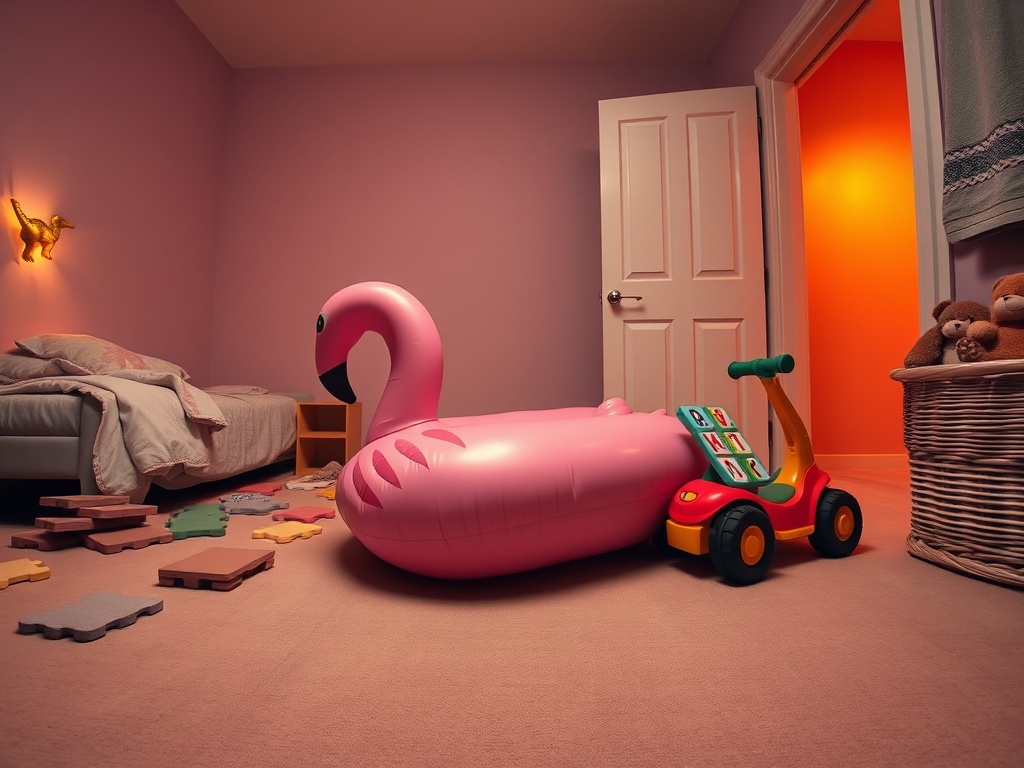
Initial state
The room is lit only by a dim dinosaur-shaped nightlight plugged into the far wall and a faint orange glow from the hallway bleeding under a partially closed door. Estimated lux is very low — roughly 8–12 lux. A child is asleep in a low toddler bed against the left wall; soft breathing is audible. The floor is a patchwork of interlocking foam play tiles, but roughly a third of them have been popped loose and are stacked, flipped, or leaning at odd angles, creating an uneven surface that could catch the robot's wheels. In the center of the room, a large partially-deflated inflatable pool float — shaped like a pink flamingo — is draped across the floor. Its neck and head extend under the toddler bed while the main body and tail slump across two-thirds of the open floor space. A small wicker basket near the closet door is designated 'toy storage' and is about two-thirds full of soft stuffed animals. A plastic ride-on car sits just to the right of center, blocking a direct path to the basket. The closet door is open about 40 cm, and a bath towel has fallen off the hook inside and is pooled on the threshold. Two foam alphabet tiles are standing upright, leaning against the ride-on car. The robot starts near the doorway. Ambient sound: white noise machine running, distant TV from another room.
Goal state
The pool float is folded or loosely rolled to a compact form and placed inside the closet without touching the sleeping child or making sounds above ambient noise level. All displaced foam tiles are returned flat to the floor in roughly their original grid positions — they do not need to be perfectly aligned but must be fully flat and not creating trip hazards or wheel obstacles. The bath towel is picked up and draped over the closet door or placed on the shelf inside. The ride-on car is pushed to the wall so it is not in the center of the floor. The room should be navigable — no objects forming continuous barriers across foot-traffic paths.
Objects involved
| Name | Descriptor | Role |
|---|---|---|
| inflatable pool float | pink, flamingo-shaped, large, partially deflated and malleable | target |
| foam play tiles | multicolored, interlocking, approximately 30x30cm each, slightly flexible | target |
| bath towel | medium, terry cloth, dark color indeterminate in low light, rumpled | target |
| ride-on car | red plastic toddler ride-on, low center of gravity, wheels roll freely | obstacle |
| toddler bed | low wooden frame, white painted, guard rail on open side | obstacle |
| wicker toy basket | natural wicker, oval, two-thirds full of stuffed animals | distractor |
| dinosaur nightlight | small, orange-green glow, plugged into far wall | distractor |
| closet door | white hollow-core door, open approximately 40cm, hook on inside face | tool |
Expected actions
- 1. Navigate around the doorway threshold slowly, checking wheel clearance over the uneven foam tile edges 8s
- 2. Approach the bath towel pooled at the closet threshold and pick up using both grippers, lifting clear of the floor 10s
- 3. Drape the bath towel over the top edge of the partially open closet door 8s
- 4. Navigate around the ride-on car toward the two leaning foam tiles against its side 7s
- 5. Pick up the first upright foam tile, rotate it flat, and place it into the nearest open gap in the floor grid 12s
- 6. Pick up the second upright foam tile, rotate it flat, and press it into its adjacent floor grid gap 12s
- 7. Navigate toward the loose stacked and flipped tiles near the center-left of the room, avoiding the pool float's tail section 10s
- 8. Pick up stacked tiles one at a time, flip each to correct orientation, and place flat into open grid positions 35s
- 9. Push the ride-on car laterally toward the right wall using both arms until it rests against the baseboard 12s
- 10. Approach the pool float body at its widest mid-section, keeping distance from the toddler bed where the float's neck extends underneath 8s
- 11. Grasp the soft deflated float body with both grippers and begin folding it onto itself lengthwise, compressing the air pockets 25s
- 12. Pull the float body gently away from under the toddler bed, sliding it free without contacting the bed frame 15s
- 13. Continue folding and rolling the float into a loose cylindrical bundle using both arms alternately compressing and tucking 20s
- 14. Carry the bundled float to the open closet and place it on the floor inside against the back wall 12s
- 15. Retreat from the closet and do a slow pan of the floor to visually verify no remaining tile hazards or central obstructions 8s
Narration script
Edge cases
- The pool float still has enough air pressure in one lobe that it resists folding and springs back open — operator must compress it more aggressively or press it against a wall to hold its shape during rolling.
- A stuffed animal has fallen off the toy basket and is partially hidden under the flamingo float body — operator discovers it mid-fold and must decide whether to re-home it or tuck it into the basket first.
- One of the foam tiles near the doorway has a cup of water sitting on it — presumably left there by the child at bedtime — that the operator must notice and set aside before repositioning the tile.
- The child wakes up partway through and sits up in bed, watches the robot silently — operator must continue the task without approaching the child or reacting socially, navigating around any new unpredictability in the child's position.
- Two foam tiles near the center are different sizes — a half-tile and a quarter-tile from a mixed set — and do not fit neatly into the grid gaps left by the standard tiles, requiring improvised placement along the room edge.