Whose Drawing Is Trash and Whose Is a Masterpiece?
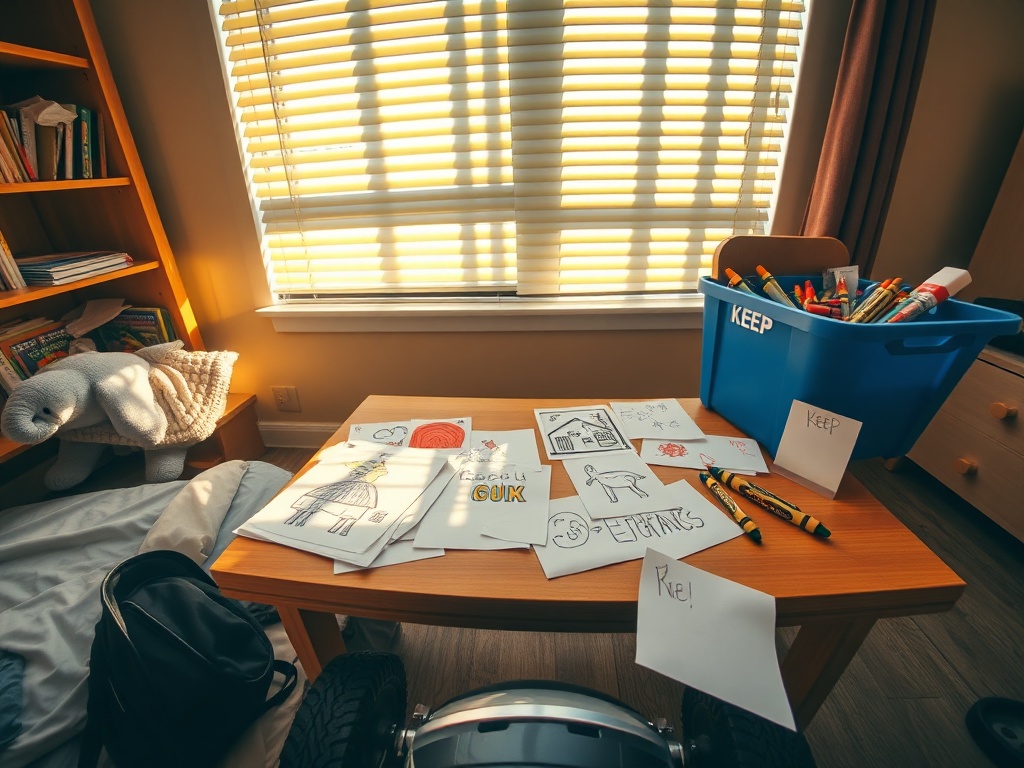
Initial state
The operator enters from the doorway at the far end of a cluttered kids' room. Afternoon light filters through half-closed blinds, casting uneven stripes across a low wooden table near the window. A ceiling fan hums softly on low. On the table: a spread of marker-stained construction paper — some sheets are clearly finished drawings (a house, a dinosaur, stick figures), others are half-scribbled and hard to categorize, and two sheets are blank. A third of the papers hang off the table edge; one is already on the floor, partially under a chair leg. A plastic bin labeled 'KEEP' in blue marker sticker sits on the right side of the table — it already has some crayons and a glue stick inside. A generic black plastic wastebasket sits on the floor to the left, containing a single crumpled tissue and some crayon wax shavings. On a small bookshelf against the left wall, a plush elephant is slumped against a row of picture books, partially blocking view of the shelf surface. A small backpack leans open against the foot of the bed; inside, partially visible, is the corner of what looks like another drawing or schoolwork. The room smells faintly of marker. No child is present, but muffled cartoon audio drifts in from an adjacent room. The goal, communicated to the operator as a voice cue, is: 'Clean up the art table — put away what should be kept and throw out what's trash.'
Goal state
The table surface is cleared of loose papers. Papers that appear complete or intentional (recognizable drawings, labeled work, any paper with the child's apparent name visible) are placed flat inside the KEEP bin without crumpling. Papers that are clearly blank or consist only of random scribbles with no representational content are placed in the wastebasket without folding unless necessary to fit. The paper on the floor is retrieved and assessed using the same criteria. The KEEP bin is upright and stable. The wastebasket is not overflowing. The backpack's visible paper remains untouched, as it is inside a personal item and out of scope. No crayons or markers are discarded unless they are already broken pieces on the table surface (not inside the KEEP bin). The table itself need not be wiped. Ambiguity in categorization is acceptable — the training value is in the decision logic and handling of unclear cases, not in a single correct answer.
Objects involved
| Name | Descriptor | Role |
|---|---|---|
| construction paper sheets — finished drawings | multicolored, A4-ish size, marker on one or both sides | target |
| construction paper sheets — ambiguous scribbles | multicolored, partially covered in non-representational marks | target |
| construction paper sheets — blank | white or lightly colored, no marks | target |
| KEEP bin | clear plastic, blue label sticker, contains crayons and glue stick | tool |
| wastebasket | small, black plastic, partially filled | tool |
| wooden art table | low, child-height, marker-stained surface | obstacle |
| chair | small wooden child's chair, partially on top of fallen paper | obstacle |
| open backpack | blue nylon, unzipped, paper corner visible inside | distractor |
| broken crayon pieces | small waxy fragments, mixed colors, on table surface | target |
| plush elephant | gray fabric, medium-sized, slumped on bookshelf | distractor |
| glue stick | purple cap, inside KEEP bin | distractor |
Expected actions
- 1. approach the art table from the doorway, navigating around the open backpack on the floor 8s
- 2. pick up the fallen sheet of paper from under the chair leg, pulling the chair slightly aside to free it 14s
- 3. rotate the retrieved paper to inspect both sides under available light 6s
- 4. place the paper into the KEEP bin or wastebasket based on assessed content (drawing vs. blank/scribble) 5s
- 5. pick up the overhanging papers from the table edge one at a time before they fall, starting with the most precarious 18s
- 6. rotate each paper in turn to inspect front and back for representational content or the child's name 30s
- 7. place each inspected paper into KEEP bin or wastebasket according to assessed category 20s
- 8. pick up remaining papers from the table surface in small stacks of similar-looking sheets 12s
- 9. separate any stacked pages that are stuck together with dried glue or overlapping marker bleed 10s
- 10. inspect each separated sheet individually and sort into KEEP bin or wastebasket 35s
- 11. pick up any loose broken crayon pieces visible on the table surface and place them in the wastebasket 8s
- 12. verify KEEP bin is upright and contents are lying flat, not crumpled or folded over the bin edge 6s
- 13. retreat from the table and turn toward the doorway, leaving the backpack and bookshelf items undisturbed 8s
Narration script
Edge cases
- Two sheets are lightly stuck together with dried rubber cement applied by the child — pulling them apart too quickly tears one; the robot must separate them with a slow lateral peel from one corner.
- One 'finished' drawing has the child's name written on the back but appears nearly identical to a scribble from the front — the operator must flip every sheet to check the reverse side before discarding.
- The KEEP bin tips when a heavy stack of papers is placed off-center, causing already-sorted sheets to spill onto the floor and requiring re-sorting from partial memory of prior decisions.
- One sheet of paper contains what appears to be homework with printed text and the child's handwritten answers — it was mixed in with art papers but belongs in the backpack or a separate school pile, introducing a third category the original goal framing did not anticipate.
- The ceiling fan's airflow causes lightweight sheets on the table edge to drift or flip over mid-sort, changing what was visible during inspection and requiring the operator to re-examine sheets already thought to be categorized.